Free research
US Data Center Construction Spending: Monthly Tracker 2026
- Research desk
- Yield Theory Research
- Reviewed
- Evidence
- 1 external reference · Method
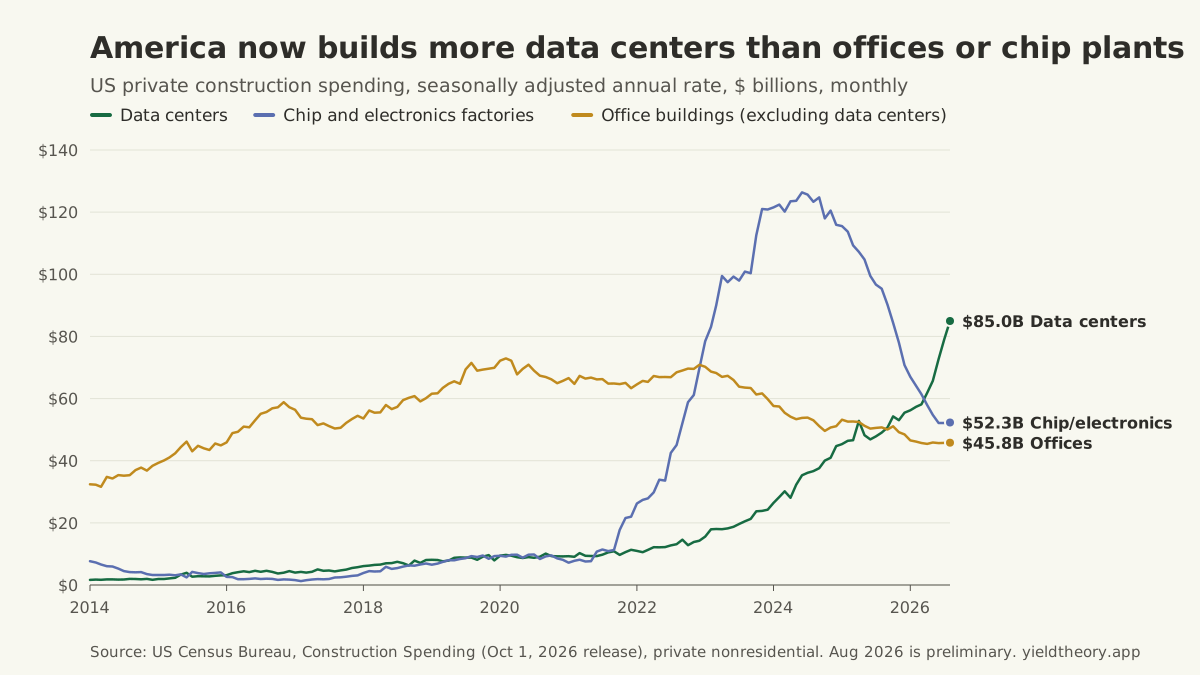
Americans are now spending money on data center construction at a rate of $85.0 billion a year. In August 2026, that was 73% more than a year earlier and more than double the pace of August 2024. Data centers now take 11% of all private nonresidential construction spending in the US, up from 4.6% two years ago.
Data centers are now the largest technology build in the country, though still below the $126 billion peak that chip factories reached in 2024. In September 2025, data center construction passed office buildings for good. In December it passed warehouses. In April 2026 it passed chip and electronics factories, the previous big technology build. We track the monthly figures from the US Census Bureau below.
The short version
- Latest month: $85.0 billion at a seasonally adjusted annual rate in August 2026 (preliminary), up from $49.1 billion in August 2025.
- Momentum: spending has risen nine months in a row, and the last three months added $19.3 billion to the annual rate.
- The handoff: chip and electronics factory construction peaked at $126.4 billion in June 2024 and has since fallen to $52.3 billion. Data centers took its place as the biggest technology build.
- The scale: these are buildings and their power and cooling systems only. The chips and servers inside cost far more and aren't counted here.
Data: US Census Bureau, Construction Spending, October 1, 2026 release, private construction, seasonally adjusted annual rate. Next release: early November, with September data. We update monthly.
US data center construction spending by month
| Month | Data centers | Change vs a year earlier | Office buildings (excluding data centers) | Chip and electronics factories |
|---|---|---|---|---|
| August 2026 (preliminary) | $85.0bn | +73% | $45.8bn | $52.3bn |
| July 2026 | $79.0bn | +65% | $45.7bn | $52.1bn |
| June 2026 | $72.7bn | +55% | $45.7bn | $52.1bn |
| May 2026 | $65.7bn | +36% | $45.8bn | $54.8bn |
| April 2026 | $61.9bn | +17% | $45.4bn | $57.9bn |
| March 2026 | $58.1bn | +25% | $45.7bn | $61.4bn |
| February 2026 | $57.4bn | +24% | $46.1bn | $64.1bn |
| January 2026 | $56.2bn | +24% | $46.6bn | $67.0bn |
| December 2025 | $55.5bn | +24% | $48.5bn | $70.8bn |
| September 2025 | $50.7bn | +35% | $50.1bn | $90.2bn |
| August 2025 | $49.1bn | +34% | $50.7bn | $95.4bn |
All figures are seasonally adjusted annual rates: what a full year would total if that month's pace held. Census revises recent months, so the latest two or three can move.
Note April: data centers briefly passed offices in April 2025 ($52.8 billion vs $52.5 billion), fell back, then passed them for good in September 2025. The year-over-year comparison for April 2026 is low for the same reason.
Data center construction by year
| Year | Average annual rate | Growth | Share of private nonresidential construction |
|---|---|---|---|
| 2014 | $1.8bn | 0.5% | |
| 2016 | $4.1bn | 0.9% | |
| 2018 | $6.9bn | 1.5% | |
| 2019 | $8.5bn | +22% | 1.7% |
| 2020 | $9.2bn | +9% | 1.9% |
| 2021 | $9.9bn | +8% | 2.0% |
| 2022 | $12.6bn | +26% | 2.1% |
| 2023 | $20.0bn | +59% | 2.7% |
| 2024 | $34.7bn | +74% | 4.4% |
| 2025 | $49.7bn | +43% | 6.3% |
| 2026, January–August | $67.0bn | +35% vs 2025 average | 8.9% |
The average of the monthly annual rates is close to the year's total. Census began reporting data centers separately in 2014.
Two things stand out. The build was steady but small for years, growing about 8% to 9% a year in 2020 and 2021. Then ChatGPT launched in November 2022, and growth jumped to 59% in 2023 and 74% in 2024. After slowing to 43% in 2025, spending sped up again in 2026.
The handoff from chip factories to data centers
The first wave of the AI and reshoring boom was factories. Spending on computer, electronics and electrical plants, much of it semiconductor fabs backed by CHIPS Act grants, went from $12.0 billion in 2021 to an annual rate of $126.4 billion in June 2024. It has since fallen by more than half, to $52.3 billion, as those projects finished.
Data centers have filled the gap. Total private manufacturing construction fell from its September 2024 peak of $249.1 billion to $168.2 billion in August 2026. Over the same period, data center construction rose by $47.4 billion. For construction firms, electricians and equipment suppliers, the work has moved from fabs to server halls. The two need many of the same trades: electrical work, cooling, power distribution and clean, reliable power.
Power is the other half. Private electric power construction, which includes generation and grid work, was running at $141.2 billion in August 2026, up 11% from a year earlier.
How this compares with Big Tech's capex
Data center construction is a small part of the AI bill. In 2025, US data center construction averaged about $50 billion. Microsoft, Amazon, Alphabet and Meta spent $376 billion on capex the same year, according to their filings (our breakdown).
The two numbers don't measure the same thing. Census counts US construction by every builder, including colocation companies that rent space to others, and it excludes equipment. Big Tech capex is global and includes servers, chips and networking. Still, the comparison shows where the money goes: the building, power and cooling are a minority of the cost. Most of it buys the chips and servers inside, which have to be replaced every few years. That's why depreciation matters so much for the companies doing the spending.
Our read
The data center build isn't slowing. It's speeding up. Three straight monthly gains of $5.9 billion to $7.0 billion in the annual rate, including the two largest in the series, after a flat patch in mid-2025, suggests the projects behind Big Tech's 2026 budget raises are now breaking ground. With the four largest spenders guiding to $720 billion to $745 billion of 2026 capex (tracker), there's room for more.
For investors, the more useful signal is who gets paid. Construction spending is revenue for the companies that build, wire, cool and power these buildings, and it arrives before the chips do. The firms that did well on the fab boom have had to replace that work, and the data in this tracker says they have.
The risk is the same one that hit chip factories: construction booms end when projects finish faster than new ones start. If the monthly rate stops rising for several months while Big Tech's budgets keep climbing, that would suggest the bottleneck has moved to power or equipment, not demand.
Frequently asked questions
How much is spent on data center construction in the US?
US private data center construction was running at a seasonally adjusted annual rate of $85.0 billion in August 2026, according to the Census Bureau's preliminary estimate. That's up 73% from $49.1 billion a year earlier. For all of 2025, spending averaged an annual rate of $49.7 billion, up 43% from 2024. Data centers now account for about 11% of all private nonresidential construction spending.
Is data center construction still growing?
Yes. The annual rate has risen for nine consecutive months through August 2026. The two largest monthly increases since Census began the series in 2014 came in June 2026 ($7.0 billion) and July 2026 ($6.3 billion), and August added another $5.9 billion.
Does data center construction spending include servers and GPUs?
No. Census construction spending covers the building, site work and installed systems such as electrical, cooling and power distribution. Servers, GPUs and networking equipment are business equipment, not construction, so they aren't included. That's why Big Tech's capex, which includes equipment, is several times larger.
When did data centers pass office construction?
Data center construction first edged above general office construction in April 2025, fell back, then passed it for good in September 2025. By August 2026, data centers ($85.0 billion) were running at nearly twice the rate of office buildings ($45.8 billion).
Limits of this data
- Census figures are estimates, and recent months are revised. August 2026 is preliminary.
- The series covers private construction in the US only. It doesn't show which companies are building or where.
- Seasonally adjusted annual rates exaggerate month-to-month noise; trends over several months are more reliable.
- "Office buildings" here is Census's general office category, which excludes data centers and financial buildings.
Go deeper with member research
Construction spending is revenue for the companies that build and power these sites, and it arrives first. Member reports pick the ones that keep the profit:
- Comfort Systems and the scarce capacity behind AI construction: why mechanical and electrical contractors have pricing power while data center demand runs ahead of skilled labor.
- GE Vernova and the value of delivering dependable power: the turbines and grid equipment behind the electric power line in this tracker.
- Issue 02: The AI Capex Shock: where the next infrastructure dollar goes and which bottlenecks keep pricing power.
Companies in this research
Continue the research
Members-only research
Members are reading this
Aug 12, 2026
Issue 05: NVIDIA Is Building the Credit Market for AINVIDIA has found a way to turn knowledge of its own roadmap into a lower cost of capital for its customers. The result could move AI infrastructure from venture equity into private credit, insurance balance sheets and securitized debt.
Sep 22, 2026
Meta jumped 11%. What must happen next to justify the price?A member research report on Meta’s AI rally: Muse, subscription economics, the cash-flow burden, legal costs and the earnings assumptions behind the new price.
The thesis, the numbers behind it, and what would break it. Full access is $39 a month.
Read the full research