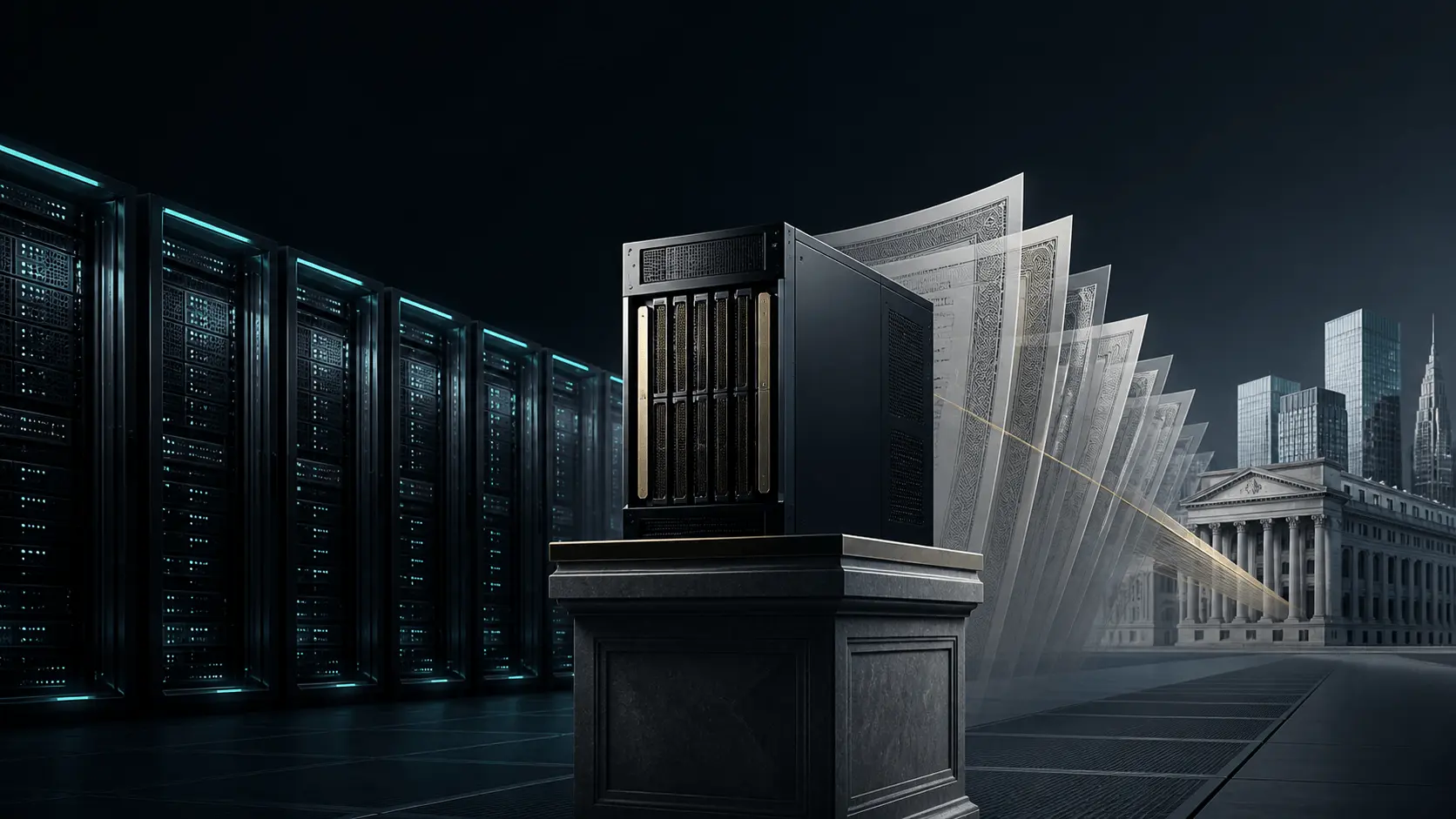
Six Wall Street platforms and selective residual-value support could move AI infrastructure from venture equity into institutional credit.
NVIDIA has signed memorandums of understanding, not final financing agreements. The allocation, collateral, pricing, fees and loss mechanics of the new platforms are not public. This issue labels the next securitization steps as analysis rather than completed transactions.
Watch it play outAI clusters could swap venture equity for institutional credit
Today an AI cloud often needs venture-equity money, with venture-equity returns, to finance a cluster.
Six Wall Street platforms, plus selective NVIDIA support, could move that financing into institutional credit.
Private credit, insurance balance sheets and securitized debt would carry the load.
So far NVIDIA has signed memorandums of understanding. Allocation, collateral, pricing, fees and loss mechanics are not public.
Illustration created with an AI image-generation tool; art direction and editing by Yield Theory.
NVIDIA has spent years convincing engineers that a GPU is not merely a chip. It is a system: accelerators, networking, software, developer tools and a workload ecosystem held together by CUDA.
Watch it play outNVIDIA's argument: a GPU is not a chip, it is a system
Look closely and a GPU is a chip: an accelerator.
Pull back and NVIDIA sells everything around it: networking, software and developer tools.
A workload ecosystem binds it into one system, held together by CUDA.
Now Jensen Huang is selling the same argument to a different audience.
Watch it play outBring in lenders, and the money comes back as GPU orders
NVIDIA sells GPU systems to AI clouds.
But a specialist cloud can have customers waiting and still be unable to spend several billion dollars on a cluster.
So Jensen Huang takes the same "GPU is a system" argument to a new customer: Wall Street.
Lenders fund the clouds, and the clouds buy more NVIDIA systems. That is the circle closing.
On August 10, NVIDIA announced memorandums of understanding with Apollo, BlackRock, Blackstone, Brookfield, Goldman Sachs and KKR. The six independent platforms are designed to mobilize more than $500 billion of third-party capital for AI infrastructure over time.
One day later, Huang supplied the missing piece. In a statement explaining the financing model, he said NVIDIA may provide a residual-value support mechanism for up to 25 percent of an opportunity, assessed project by project.
Watch it play outSix partners, a $500 billion target, and support on a quarter of a deal
On August 10 NVIDIA signed MOUs with Apollo, BlackRock, Blackstone, Brookfield, Goldman Sachs and KKR.
The six platforms are designed to mobilize more than $500 billion of third-party capital over time.
A day later Huang said NVIDIA may provide residual-value support for up to 25% of an opportunity, assessed project by project.
That quarter is the slice lenders hesitate over: the unknown value of an older GPU generation.
Source: NVIDIA and Jensen Huang, August 2026
That is the circle closing.
The company with the best information about when a new GPU generation will arrive is offering limited protection against the risk that makes lenders hesitate: the unknown value of the old generation.
Check the claimThree claims to test as you read
NVIDIA is not becoming a bank. It is trying to write the underwriting standard for an asset class whose financing directly expands its own addressable market.
If it works, an AI cloud will no longer need venture-equity returns to finance every cluster. A project with a credible customer contract, a transferable compute system and a supportable residual value can borrow from private-credit funds, insurance balance sheets and fixed-income investors.
Watch it play outThree ingredients turn a cluster into something lenders can fund
Take a project with a credible customer contract, a transferable compute system and a supportable residual value.
Together they make one financeable project.
It can borrow from private-credit funds, insurance balance sheets and fixed-income investors, without venture-equity returns.
That lowers the cost of capital. It also changes who owns the downside.
That lowers the cost of capital. It also changes who owns the downside.
The $500 billion headline is not the deal
The announcement is easy to overstate.
Spot the red flag
Tap the phrase you think is the tell.
Spotted it.Not that phrase. The headline is aggregate third-party capital the platforms are designed to mobilize over time. NVIDIA's residual support is optional and capped at 25% of a selected opportunity, not 25% of the headline.
“The six independent platforms” Telling, since there is no single fund, but the bigger tell is what kind of money the number describes.
“are designed to mobilize” A design goal, not committed money. The partnerships remain subject to final agreements.
“more than $500 billion” The number is real as a target. The words around it say what kind of target.
“of third-party capital” The money comes from the six partners and their investors, not from NVIDIA's balance sheet.
“for AI infrastructure over time” Over time matters too, but the sharper tells are earlier in the sentence.
Source: NVIDIA and Jensen Huang, August 2026
There is no single $500 billion fund. NVIDIA has not committed $500 billion of its balance sheet. The six financial institutions have not agreed to finance every NVIDIA customer. The announcement consists of memorandums of understanding, and NVIDIA says the partnerships remain subject to final agreements.
Huang described the headline number as aggregate third-party capital the platforms are designed to mobilize over time. Each financial institution will independently assess the borrower, customer demand, utilization, cash flow and residual value.
Watch it play outThe $500 billion is six separate platforms, not one fund
The headline reads like one $500 billion fund.
There is no single fund. Six independent platforms are designed to mobilize third-party capital over time; the allocation is not public.
Each institution will independently assess the borrower, demand, utilization, cash flow and residual value. None of it is NVIDIA's balance sheet.
Source: NVIDIA and Jensen Huang, August 2026
The residual support is similarly bounded. NVIDIA may provide it. The maximum is up to 25 percent of a selected opportunity. Nothing public says NVIDIA will support one quarter of the entire $500 billion target. The trigger, duration, seniority, recovery process and accounting treatment have not been disclosed.
Those limits make the announcement smaller in a legal sense and more interesting in a strategic one.
Watch it play outSupport only has to lift the deals that almost clear
Picture AI projects measured against a lender's hurdle.
The interesting ones almost clear it: their cash flows work only if the lender trusts the hardware's recovery value.
A limited, contingent promise can narrow that gap and lift them over the line.
So NVIDIA doesn't need to supply most of the money. It needs to change recovery assumptions on deals near the hurdle.
NVIDIA does not need to supply most of the money. It needs to change the recovery assumptions on the deals that almost, but not quite, clear a lender's hurdle.
Consider a project whose cash flows support a loan only if the lender believes the hardware can be redeployed after a customer default. A limited vendor support mechanism can narrow the gap between the lender's conservative recovery value and the price required to fund the project. If that enhancement improves the rating, reduces the required equity or lowers the interest spread, a relatively small contingent promise can unlock a much larger pool of third-party capital.
A small contingent promise can unlock a much larger loan
Recovery gap (Conservative value below funding need) to Vendor support (A limited, contingent promise)
Vendor support (A limited, contingent promise) to Better loan terms (Rating, equity or spread improves)
Better loan terms (Rating, equity or spread improves) to Larger capital pool (More third-party money)
The mechanism the announced architecture is designed for. Whether signed terms deliver it is not yet public.
The signed terms will determine whether that is the actual effect. The announced architecture is plainly designed for it.
Executive judgment
Seven conclusions shape our view.
NVIDIA is attacking the financing constraint behind its own demand. The company already helps define the hardware, software and operating architecture. The new platforms add capital formation to that stack.
The 25 percent support is depreciation insurance only in a loose sense. It is residual-value support, not a published guarantee against every decline in a GPU's market price. The exact loss waterfall is unknown.
Banks are not lending against loose GPUs. The strongest transactions combine customer contracts, operator and completion risk, hardware, the powered site and sometimes a vendor or customer backstop.
Investment-grade GPU credit already exists. CoreWeave and IREN closed rated facilities months before the NVIDIA announcement. The new initiative is an attempt to make those bespoke successes repeatable at much greater scale.
NVIDIA's reference-design role is already real. DSX standardizes chip-to-grid architecture, simulation and operations. That can reduce diligence and completion risk, even though it cannot make every data center interchangeable.
Securitization is a credible destination, not an announced NVIDIA product. Broadcom's separate AI XPV platform has already demonstrated tranching. NVIDIA has not disclosed a pooled ABS, CLO or CDO.
The systemic risk is correlation, not the acronym. A pool with many borrowers can still be one trade if every recovery value depends on the same AI-demand curve, NVIDIA roadmap and compute-rental market.
Jensen found the invisible bottleneck
The industry usually describes the AI buildout as a shortage of chips, power, cooling equipment, transformers or grid connections.
Those are physical constraints. Financing is the constraint behind them.
A startup or specialist cloud can have customers waiting for capacity and still be unable to spend several billion dollars on a cluster. Equity is expensive and dilutive. Ordinary corporate debt may be unavailable because the borrower has little operating history, negative free cash flow and enormous concentration in one technology cycle.
Project and object finance offer a different question.
Instead of asking whether the startup deserves an unsecured corporate loan, the lender asks whether a ring-fenced asset and its contracts can repay the debt.
The model resembles aircraft, shipping, telecom towers and energy projects more than venture lending:
Institutional investors provide debt and equity to a special-purpose vehicle.
The vehicle buys an integrated compute system and may own or control the associated data-center infrastructure.
An offtaker signs a contract to use the capacity and makes recurring payments.
Those payments service the debt.
If the customer defaults, lenders exercise contractual remedies over the project assets, contracts and accounts.
If resale proceeds fall short, a customer prepayment, reserve, subordinated capital or vendor support may absorb part of the loss.
Lenders underwrite the cash flows, not loose GPUs
Institutional capital (Funds, insurers, banks) to Project vehicle (SPV) (Owns the compute system): Debt and equity
Project vehicle (SPV) (Owns the compute system) to NVIDIA and OEMs (AI systems and networking): Buys AI systems
Project vehicle (SPV) (Owns the compute system) to Offtaker (Contracts to use the capacity): Provides capacity
Offtaker (Contracts to use the capacity) to Project vehicle (SPV) (Owns the compute system): Usage payments
Project vehicle (SPV) (Owns the compute system) to Institutional capital (Funds, insurers, banks): Debt service
Simplified flow. If resale proceeds fall short, a customer prepayment, reserve, subordinated capital or optional NVIDIA support may absorb part of the loss. The exact platform terms are not public.
This structure changes the relevant cost of capital.
Venture equity prices the possibility that the company fails. Senior project debt prices the probability that a contracted payment stream and recovery package fail to repay the specific loan. Those can be very different risks.
The financing platforms therefore do more than allow weak borrowers to purchase chips. At their best, they separate the credit quality of a project from the corporate risk of the company sponsoring it.
That is how AI infrastructure begins to move out of venture capital and into the “big leagues” of private investment-grade credit, insurance capital and capital markets.
The GPU is only one layer of the collateral
The phrase “GPU-backed loan” encourages a misleading mental model: a bank lends $1 billion, takes a lien on a warehouse of accelerators and expects to auction them if the borrower fails.
The hardware matters. It is not the whole loan.
CoreWeave's public filings show how lenders protect themselves. One facility restricted borrowing to a percentage of the depreciated purchase price of GPU servers and related infrastructure, with the percentage tied to the credit rating of the customer contract being financed. Obligations were secured by substantially all assets of the borrowing subsidiary.
IREN's June financing is even clearer. The company said its $3.65 billion facility was secured by the GPUs and associated contracted cash flows supporting its Microsoft deployment. Customer prepayments, the Microsoft contract, the equipment and the data-center infrastructure worked together.
The lender is underwriting at least five things.
A GPU loan is really five underwriting decisions
Offtaker creditWill the customer keep paying the capacity contract?
Completion and operatorCan the project arrive on time and stay utilized?
Compute systemCan the fleet serve other workloads and operators?
Site and powerCan the powered facility host a replacement generation?
Support layerWho covers a shortfall after default and resale?
What the lender underwrites
The chip matters, but the repayment stream matters more.Source: CoreWeave and IREN financing disclosures
The offtaker
A five-year capacity contract with Microsoft is not economically equivalent to a two-year promise from an early-stage AI lab. Customer credit determines how much of the future payment stream a lender will recognize and how much equity must sit beneath the debt.
The operator
A cluster that arrives late cannot generate the expected cash flow. Completion guarantees, liquidated damages, construction reserves, performance tests and experienced operators matter before residual value becomes relevant.
The compute system
A GPU installed inside an integrated rack is not a commodity bar of copper. Networking, memory, cooling, firmware, software and workload compatibility determine what the system can earn and how costly it is to redeploy.
The powered site
Grid access, cooling capacity and network connectivity can outlive a particular chip generation. A lender may recover more from an energized, reusable campus than from removing thousands of servers and selling them individually.
The support layer
Vendor residual support can cover part of a shortfall. Customer prepayments, subordinated capital, reserves and overcollateralization can provide additional protection. The structure decides who absorbs the first dollar of loss.
This is why “worst case, the bank owns the GPUs” is incomplete.
The real worst case is that the bank controls a half-completed facility in the wrong location, with a cancelled customer contract, obsolete networking, a falling rental market and thousands of accelerators that cost money to remove and recommission.
The bankability of the asset depends on preventing that entire failure sequence, not merely attaching a serial number to each chip.
Make a guess
Spot on.Close, a little low.Close, a little high.Way off, too low.Way off, too high. It was SOFR + 9.62%.
SOFR + 9.62%, disclosed later in an SEC filing. By March 2026, CoreWeave's rated, non-recourse $8.5 billion facility priced its floating tranche at SOFR + 2.25%. The loans differ in contracts, collateral and recourse, and that difference is the point.
CoreWeave, July 2023SOFR + 9.62%
CoreWeave, March 2026 floating trancheSOFR + 2.25%
Source: CoreWeave SEC filings
The cost of GPU credit has already collapsed
NVIDIA did not invent GPU-backed finance this week. It is industrializing a market that already moved from expensive private credit toward investment-grade structures.
In July 2023, CoreWeave entered a $2.3 billion delayed-draw term loan facility to finance GPU servers and related infrastructure. A later SEC registration filing disclosed a term-SOFR margin of 9.6196 percent on that facility.
By March 2026, CoreWeave had closed a very different non-recourse $8.5 billion facility. The loan was secured by a ring-fenced subsidiary's assets and associated with a customer contract. Moody's rated it A3 and DBRS rated it A(low). The floating tranche priced at SOFR plus 2.25 percent; the fixed tranche priced at approximately 5.9 percent.
In June, IREN closed $3.65 billion at a blended 6 percent. Fitch and DBRS rated the transaction A and A(low). The financing included a $2.10 billion US private placement and a $1.55 billion delayed-draw loan.
IREN said the debt plus a $1.94 billion Microsoft prepayment would fund about 96 percent of $5.81 billion of GPU capital expenditure. Its stated 3.31 percent average financing cost treats the zero-cost customer prepayment as part of the funding balance; it is not the coupon on the debt.
Debt plus Microsoft's prepayment fund about 96% of IREN's GPU spending
GPU capital expenditure$5.81B
36%$2.10BUS private placement
27%$1.55BDelayed-draw loan
33%$1.94BMicrosoft prepayment
The prepayment costs nothing, which is why IREN's stated 3.31% average financing cost sits below the 6% blended rate on the debt.Source: IREN, June 2026
The comparison is not apples to apples. The 2026 loans had stronger contracts, different collateral, different recourse and a more mature market. That is precisely the point.
GPU credit was getting cheaper before NVIDIA's platform
Jul 2023CoreWeave $2.3B loanDelayed-draw term loan at SOFR + 9.62%
Mar 2026CoreWeave $8.5B facilityNon-recourse, rated A3 and A(low), SOFR + 2.25%
Jun 2026IREN $3.65B financingRated A and A(low), 6% blended
Aug 2026NVIDIA platformsSix MOUs targeting more than $500B
The facilities differ in customer credit, collateral, recourse and maturity, so the spreads are not a clean time series. They show the widening set of institutional financing options.Source: CoreWeave SEC filings; IREN, June 2026; NVIDIA, August 2026
GPU financing became cheaper because the asset stopped being presented as an isolated chip purchase. It became a rated bundle of contracted revenue, equipment, infrastructure and legal protections.
The best AI infrastructure projects already borrow more like infrastructure. NVIDIA's platform aims to move the marginal qualifying project in the same direction.
NVIDIA can price the risk nobody else can see
Jensen Huang, founder and chief executive of NVIDIA. Official portrait: NVIDIA.
Every lender financing a GPU fleet faces a peculiar conflict.
Demand may remain strong while the collateral becomes economically obsolete. A newer generation can deliver enough improvement in performance per watt or cost per token that the old fleet loses pricing power before it stops functioning.
NVIDIA knows more about that transition than any bank.
It knows the internal roadmap, the likely production ramp, the software support plan and which workloads can remain on older hardware. It can see demand across cloud providers, sovereign customers, AI labs and enterprises. CUDA gives it an additional lever: software updates can improve the output of installed systems and widen the workloads that remain economical.
Huang cited the A100 as proof. Introduced in 2020, the chip remains in commercial use six years later across training, fine-tuning, inference and high-performance computing. He also pointed to rising H100 rental benchmarks and premium Blackwell pricing as evidence that deployed hardware can retain revenue value.
Those figures are selected by the vendor and should be treated as part of NVIDIA's case, not an independent appraisal. The underlying argument is still strong: economic life is determined by revenue per watt, utilization and software support, not the date a newer chip appears on a slide.
That information advantage creates a rational reason for NVIDIA to write limited residual support. It may be better placed than a lender to recover, remarket, rent or redeploy its systems.
It also creates a conflict.
The party supporting old-GPU residual values is the same party economically rewarded for selling the next generation. A lender must therefore underwrite the legal promise, not Jensen's confidence. It needs explicit models, advance rates, depreciation schedules, inspection rights, triggers and recovery procedures.
NVIDIA's roadmap knowledge cuts both ways
Why NVIDIA can write support
Knows the internal roadmap and production ramp
Sees demand across clouds, sovereigns, labs and enterprises
CUDA updates can extend what installed systems earn
Better placed to remarket, rent or redeploy its systems
vs
Why lenders should be careful
The supporter of old-GPU values is paid to sell the next generation
Vendor-selected figures are not an independent appraisal
The legal promise, not Jensen's confidence, is what gets underwritten
Residual support is valuable because NVIDIA knows the roadmap. It is risky for exactly the same reason.
The reference-design thesis is already happening
The second part of the strategy is standardization.
In March, NVIDIA released the Vera Rubin DSX AI Factory reference design. It spans compute, networking, storage, power, cooling and control systems. The related digital-twin tools let operators simulate layouts, thermal behavior, power topologies and workload changes before construction.
NVIDIA describes DSX as generation-specific, repeatable and scalable. Partners across electrical equipment, cooling, engineering and data-center operations are integrating into it.
That can matter to credit in four ways.
Completion risk becomes more measurable. A validated design and pre-tested component ecosystem can reduce the number of bespoke interfaces that fail during construction.
Performance can be compared. Common telemetry makes tokens per watt, downtime, thermal limits and utilization easier to benchmark across projects.
Replacement becomes easier. A modular operating layer and documented architecture can make it less costly for another operator to take over a troubled facility.
Loan data becomes more consistent. Repeatable collateral descriptions, depreciation assumptions and operating covenants are the raw material of a scalable credit market.
This does not make data centers physically fungible.
A Rubin facility in Texas with cheap power and a Microsoft contract is not interchangeable with an H100 cluster in a constrained European grid serving an early-stage lab. Land, grid rights, latency, taxes, export controls, cooling design, chip generation, network topology and customer credit remain project-specific.
The useful kind of fungibility is narrower: a system can support multiple workloads, operators and customers; its performance can be measured against a common standard; and another party can understand what it is taking over.
That is enough to improve underwriting. It is not enough to remove project risk.
DSX standardizes the operating data, not the location
What DSX can standardize
A validated design from compute to cooling and controls
Telemetry: tokens per watt, downtime, utilization
An architecture another operator can take over
Repeatable collateral descriptions and covenants
Enough to improve underwriting
vs
What stays project-specific
Land, grid rights and latency
Taxes and export controls
Cooling design, chip generation, network topology
Customer credit
Not enough to remove project risk
Securitization is the next logical machine
Once lenders can originate many loans using repeatable documentation and performance data, the next capital-markets step is obvious.
The loans or lease receivables can be sold to a bankruptcy-remote vehicle. The vehicle issues securities with different payment priorities. Senior investors receive lower yields and absorb losses last. Mezzanine investors earn more and take losses earlier. The equity or first-loss holder receives the residual return and absorbs the first damage.
How a pool of compute loans could be tranched
Loans and leases (Repeatable data and documents) to Bankruptcy-remote vehicle (Issues the securities): Sold to
Bankruptcy-remote vehicle (Issues the securities) to Senior (Lower yield, losses last)
Bankruptcy-remote vehicle (Issues the securities) to Mezzanine (Earns more, losses earlier)
Bankruptcy-remote vehicle (Issues the securities) to First loss (Residual return, first damage)
NVIDIA has not announced a pooled GPU ABS or CLO. This path is Yield Theory analysis of a plausible market route.
The terminology matters.
An asset-backed security is serviced by cash flows from a discrete pool of loans, leases or receivables. A pool of compute leases or ring-fenced project loans could fit that economic form, subject to the legal structure.
A collateralized loan obligation owns a managed pool of loans and issues multiple tranches. If institutional lenders originate enough AI infrastructure loans, a CLO can buy them even when the underlying data centers are not physically identical.
A collateralized debt obligation is the broader historical label for structures backed by debt instruments or other structured products. It is the least useful term here because it invites a 2008 analogy before identifying the actual collateral.
Physical fungibility is helpful but not the legal switch that permits securitization. Mortgages, aircraft leases and commercial loans are never identical. What matters is whether the cash flows, loan terms, collateral data, servicing and recovery histories can be standardized enough for investors and rating agencies to model them.
The market has already crossed part of this bridge.
In June, Apollo and Blackstone announced an initial $35 billion capital solution for Broadcom's AI XPV platform, designed to finance compute capacity for Anthropic and other frontier labs. Apollo's release explicitly identified A1 and A2 financing tranches and multiple placement agents.
Bloomberg reported that Broadcom provided residual-value support in the transaction. The full support agreement is not public, so its triggers should be described as reported rather than independently reconstructed.
The precedent is strategically important. Tranching AI compute is no longer a thought experiment. What remains unannounced is a repeatable NVIDIA program that pools multiple loans or leases and sells the resulting paper broadly.
Tranched AI compute exists; a pooled NVIDIA program does not
Already observed
Investment-grade GPU facilities at CoreWeave and IREN
Broadcom AI XPV: $35B with A1 and A2 tranches
DSX reference designs and telemetry
Compute futures planned by CME
vs
Not yet announced
A repeatable NVIDIA program pooling many loans or leases
Paper sold broadly to investors
A pooled GPU ABS, CLO or CDO
NVIDIA's six partners have the distribution machinery to attempt it. Apollo, KKR and Blackstone connect private credit with insurance capital. BlackRock and Brookfield manage long-duration infrastructure money. Goldman can originate, structure, hedge and distribute credit.
The initiative brings every part of the machine into one room.
Investment grade can arrive before securitization
There is a subtle correction to the pension-fund thesis.
AI infrastructure debt does not need to become a public ABS or CLO before insurance companies and other long-duration investors can buy it.
IREN's financing included a US private placement and participation from asset managers and insurance investors. CoreWeave's facility received investment-grade ratings as a single project financing. Apollo described the Broadcom transaction as investment-grade capital deployed through its own platform.
Securitization can widen distribution, create tradeable tranches and recycle lenders' capital. It is not the only route to the institutional balance sheet.
That distinction matters for timing. The “big leagues” transition has started even if NVIDIA never issues something called a GPU ABS.
The more useful sequence is:
Contracted projects obtain rated private loans or placements.
Documentation, servicing and collateral data become repeatable.
More lenders originate similar loans.
Banks and asset managers pool exposures or place them into managed vehicles.
Tranches match the risk tolerance of insurers, pension funds, private-credit funds and opportunistic capital.
This is a capital-formation process, not an acronym contest.
Tranching converts project risk into a common-factor trade
The original intuition is partly right: banks can trade idiosyncratic project risk for broader sector exposure.
Pooling a Texas lab, an Ohio cloud provider, a European sovereign project and an Asian enterprise reduces the damage from one construction delay or one customer's isolated default. Senior investors receive protection from diversification, subordination, excess spread, reserves and perhaps vendor support.
But every loan can still share one hidden factor.
Four regions, one shared downside factor
Common factor (AI demand, NVIDIA roadmap, rental prices) to Texas (Lab)
Common factor (AI demand, NVIDIA roadmap, rental prices) to Ohio (Cloud provider)
Common factor (AI demand, NVIDIA roadmap, rental prices) to Europe (Sovereign project)
Common factor (AI demand, NVIDIA roadmap, rental prices) to Asia (Enterprise)
Texas (Lab) to Pooled credit (Looks diversified)
Ohio (Cloud provider) to Pooled credit (Looks diversified)
Europe (Sovereign project) to Pooled credit (Looks diversified)
Asia (Enterprise) to Pooled credit (Looks diversified)
Securitization redistributes common risk; it cannot diversify it away.
Suppose every project uses NVIDIA systems. The pool appears diversified by borrower, region and use case. It may remain concentrated in:
the pace of NVIDIA's hardware roadmap;
the value of CUDA compatibility;
the same AI-demand cycle;
the same compute-rental benchmarks;
the same memory and networking supply chains;
similar power-price and grid constraints;
the same investor willingness to refinance the next generation.
If the residual values were modeled independently but are actually driven by one global compute-price shock, senior tranches can lose more than the project-by-project models imply.
This is the lesson worth carrying from 2008. It is not that all securitization is toxic. Aircraft, auto loans, equipment leases, credit cards and corporate loans have used securitization for decades.
The danger appears when a structure treats exposures as diversified even though they share the same unmodeled cause of failure.
The aircraft analogy is useful but incomplete
The sentence “worst case, we own a Boeing 787” captures object finance in six words. The aircraft can be repossessed, inspected, maintained and leased to another operator.
GPU finance is moving toward that model. It has a long way to go.
Aircraft benefit from global maintenance records, airworthiness rules, standardized return conditions, established appraisers, liquid leasing companies and decades of resale evidence. Boeing's 2026 finance outlook describes bank loans, capital markets, operating leases and sale-leasebacks as mature, competing sources of delivery finance.
An AI accelerator has a shorter product cycle and a less mature appraisal market. Its value depends heavily on the rack, network, power, cooling, software and contract surrounding it. Removing it from one facility can destroy part of the economic value the lender thought it owned.
Aircraft also age physically. GPUs can age economically overnight if a new system produces radically cheaper tokens inside the same power envelope.
The closer analogy is therefore the whole AI factory:
the GPU fleet resembles the aircraft;
the customer contract resembles the lease;
the data center and power access resemble the airport and maintenance infrastructure;
the operator and software stack preserve serviceability;
residual-value support resembles a manufacturer or lessor absorbing part of end-of-life risk.
That is why NVIDIA insists that the financeable object is not a chip. It is full-stack compute.
The closer analogy is the whole AI factory
Part of the deal
Aircraft finance
GPU finance
Financed object
The aircraft
The GPU fleet
Contract
The lease
The customer contract
Infrastructure
Airport and maintenance
Data center and power access
Serviceability
Maintenance records, airworthiness rules
Operator and software stack
End-of-life risk
Manufacturer or lessor
Residual-value support
How it ages
Physically
Economically, sometimes overnight
Resale evidence
Decades, established appraisers
Less mature appraisal market
Compute futures complete another part of the market
Collateral becomes easier to finance when lenders can observe a price and hedge it.
Silicon Data now publishes daily rental-price benchmarks for A100, H100, H200, B200 and AMD MI300X capacity. Its July readings show why one universal “GPU price” is impossible: H100 prices differ sharply between specialist clouds and hyperscalers, while each chip generation carries its own curve.
In May, CME announced plans to launch compute futures based on Silicon Data indices later in 2026, pending regulatory review. The Information reported that Goldman Sachs and JPMorgan were exploring trading futures tied to GPU rental prices.
A cloud provider expecting to renew customer contracts next year could short a compute future. If rental prices fall, gains on the hedge could offset some of the lost revenue. A lender exposed to residual values could use a similar position.
Compute futures turn rental benchmarks into a hedge
Silicon Data indices (Daily GPU rental benchmarks) to CME compute futures (Planned, pending review): Settles on
CME compute futures (Planned, pending review) to Cloud provider (Expects to renew contracts): Gains if rents fall
CME compute futures (Planned, pending review) to Lender (Exposed to residual values): Similar position
The hedge is imperfect: it does not cover a construction delay, customer bankruptcy, network failure or loss of power.
The hedge will be imperfect.
A cash-settled H100 index does not hedge a construction delay, customer bankruptcy, network failure or loss of power. It may not track the price of a private five-year Rubin contract in another region. A benchmark based on advertised or standardized rental rates may diverge from block transactions executed under stress.
The futures market also needs enough independent buyers, sellers and market makers to create reliable liquidity. A derivative cannot reveal a price if most capacity remains locked inside private contracts and the benchmark can be moved by a thin spot market.
Compute futures are therefore important as price discovery before they are important as a perfect hedge.
They give lenders a visible forward curve for an asset class that previously relied on vendor forecasts and scattered cloud quotes.
Who benefits if NVIDIA succeeds
The first-order beneficiary is NVIDIA.
Cheaper capital lets customers buy systems sooner, at larger scale and with less equity. DSX-compatible financing also reinforces the value of the NVIDIA stack. A lender that underwrites CUDA portability, NVIDIA reference designs and NVIDIA residual support has a reason to prefer projects built around that ecosystem.
The upside has three layers:
Hardware demand arrives earlier. Financing converts future customer need into present orders.
Software adoption compounds. More financed factories expand the installed base for CUDA, networking and enterprise software.
The platform becomes the underwriting language. If ratings, appraisals and loan covenants are written around NVIDIA metrics, competing hardware faces a capital-cost disadvantage in addition to a software disadvantage.
The corresponding risks are equally important.
NVIDIA can weaken the quality of reported demand if sales increasingly depend on financing or guarantees provided by the vendor. Residual support can become a contingent obligation when customers default and resale values fall. The company may also encourage capacity that would not exist under purely independent economics.
The six financial partners gain origination, structuring, management and distribution opportunities. Apollo, KKR and Blackstone can place long-duration credit into insurance-related capital. BlackRock, Brookfield and Goldman can connect institutional investors to assets too large for ordinary private loans.
Their risk is concentration disguised as infrastructure diversification.
CoreWeave, IREN and other specialist clouds gain access to a deeper debt market. A lower spread and higher advance rate can transform project equity returns. It can also accelerate fixed obligations faster than customer diversification. The best financing still depends on a strong offtaker; the platform does not make an uncontracted cluster investment grade.
Hyperscalers already borrow at low corporate rates. Their benefit is optionality. They can lease capacity from financed third-party operators instead of carrying every project on their own balance sheets. Their contracts, prepayments and credit ratings may become the decisive collateral supporting someone else's debt.
Competing silicon vendors face a new battlefield. Broadcom moved first with a large structured platform. AMD has reportedly participated in smaller collateral-backed arrangements. The product competition is no longer only performance per dollar. It is performance per financed dollar.
Data-center equipment suppliers benefit only after the credit closes and the project reaches construction. Standardized DSX designs could pull demand through networking, power, cooling and systems partners. They also increase dependence on NVIDIA's architecture and timing.
Cheaper GPU credit spreads gains and risks unevenly
The bullish mistake will be to count the $500 billion as committed NVIDIA demand.
The bearish mistake will be to dismiss every financed purchase as circular.
Independent capital can rationally finance a project that buys NVIDIA systems. The financing becomes circular when the vendor's support, investment or purchase commitment is the reason a weak customer's revenue appears bankable, and the vendor recognizes sales before the independent end demand has proven itself.
The distinction must be measured deal by deal.
A strong transaction has:
an external customer with durable payment capacity;
meaningful customer prepayment or equity beneath the debt;
a project that can operate without repeated vendor subsidies;
conservative advance rates against depreciated equipment cost;
transparent residual-value assumptions;
replacement operators and offtakers;
no dependence on refinancing before the hardware earns back its cost.
A weak transaction has:
a customer funded by the same ecosystem that records the sale;
uncontracted capacity built on a rental-price forecast;
little first-loss capital;
a long loan against a short economic life;
vendor support whose accounting or trigger is difficult to understand;
no credible recovery plan outside an industry-wide AI boom.
The acronym on the security tells us almost nothing about which one it is.
Our base case
Our base case is not that every AI startup will suddenly borrow like a real-estate company.
It is narrower and more consequential.
Projects with a high-quality offtaker, a validated NVIDIA architecture, secured power, an experienced operator and meaningful loss protection will increasingly access investment-grade private credit. The equity requirement will fall. The cost of capital will approach infrastructure finance rather than venture equity.
This will accelerate capacity for the strongest customers and widen the gap between contracted and speculative projects.
We expect financing to develop in three layers.
First, the six platforms will close bespoke project loans, private placements and lease structures. Each will use its own balance sheet, funds, insurance capital and distribution network.
Second, lenders will converge on repeatable advance rates, useful-life schedules, telemetry, collateral controls and residual-value methods. DSX will help standardize the operating data even when the legal documents differ.
Third, banks and asset managers will distribute more of the exposure through private syndication, managed credit vehicles, project bonds and selected securitizations. A public “GPU ABS” label is possible but not necessary for the market to reach pension and insurance capital.
Shared standards (Advance rates, useful lives, telemetry) to Wider distribution (Syndication, managed vehicles, bonds)
NVIDIA's residual support will be used selectively where a modest enhancement unlocks a much larger senior financing. It is unlikely to make the weakest uncontracted project bankable.
What would break the thesis
We would become more cautious if:
final platform agreements repeatedly fail to close;
residual support is too conditional to receive lender or rating-agency value;
GPU rental benchmarks fall while utilization and customer contracts weaken;
a newer generation produces such a large cost-per-token advantage that older fleets cannot cover power and operating costs;
recovery from a specialist-cloud default reveals high removal, recommissioning or remarketing costs;
rating models treat many NVIDIA projects as diversified even though recoveries move together;
vendors recognize large sales while financing, guarantees or purchases keep the end customer alive;
insurers and private-credit funds discover they own the same AI factor across supposedly separate infrastructure portfolios.
We would gain confidence if:
the platforms disclose conservative advance rates against depreciated equipment cost;
customer contracts extend beyond the debt's weighted life;
multiple operators successfully redeploy older clusters after contract expiry;
compute indices develop transparent methodology and liquid hedging markets;
recoveries remain strong through a period of weaker AI demand;
NVIDIA reports limited, clearly capped residual obligations relative to the third-party capital mobilized;
non-NVIDIA platforms attract financing on comparable terms, proving the market is underwriting compute economics rather than one vendor's halo.
The ten signals to watch
Final agreements: which of the six MOUs become operating platforms and when.
Closed capital: funded debt, not pipeline or “designed to mobilize” targets.
NVIDIA support notional: maximum exposure, triggers, duration and accounting.
Advance rates: debt as a percentage of depreciated GPU and total project cost.
Offtaker quality: customer concentration, prepayments and contract duration.
Loan life versus compute life: weighted debt maturity against the revenue curve of the financed generation.
Rental benchmarks: H100, B200 and later Rubin prices across specialist clouds and hyperscalers.
Recovery evidence: actual resale, redeployment time and recommissioning cost after a default.
Distribution: insurance, pension, private-placement, bank, ABS or CLO ownership of the debt.
Correlation controls: how rating agencies stress a simultaneous decline in utilization, rental price and residual value.
The product NVIDIA is really selling
Jensen Huang is not merely telling banks that GPUs retain value.
He is assembling the conditions that allow a lender to believe it:
a standardized full-stack asset;
software that extends useful economic life;
a large ecosystem of potential users;
daily rental benchmarks;
reference designs and operating telemetry;
independent underwriters;
and limited residual support from the party with the best roadmap information.
That is a more sophisticated product than a guarantee.
It is a depreciation curve Wall Street can lend against.
If the curve proves reliable, AI infrastructure will no longer depend on venture capital waiting for an equity round. It will be financed by institutions that measure contracted revenue, recovery values, useful lives and loss priority.
The data-center game is already leaving the VC table.
The remaining question is not whether it enters the big leagues of credit. CoreWeave, IREN and Broadcom show that it has.
The question is whether NVIDIA can scale that market without becoming the hidden first-loss buyer of its own demand.
NVIDIA has found a way to turn knowledge of its own roadmap into a lower cost of capital for its customers. The result could move AI infrastructure from venture equity into private credit, insurance balance sheets and securitized debt.
Texas has frozen new data center approvals since the summer. The vote extends that freeze, but it cannot unplug campuses that already have power. We map who is exposed, test whether the sell-off overshot and say where the real risk sits.
The thesis, the numbers behind it, and what would break it. Full access is $39 a month.