Citadel bought the AI fire sale. The seller had run out of time.
- Research desk
- Yield Theory Research
- Reviewed
- Evidence
- 9 external references · Method
Citadel did not need a better forecast of artificial intelligence. It needed a seller who could no longer wait.
In the final week of July 2026, Leopold Aschenbrenner's AI-focused investment firm, Situational Awareness, sold the bulk of a public-equity portfolio reported to be worth roughly $16 billion to Ken Griffin's Citadel after steep losses and pressure from its lenders. The sale followed a sharp reversal in AI infrastructure stocks, the group that had powered the fund's extraordinary rise.
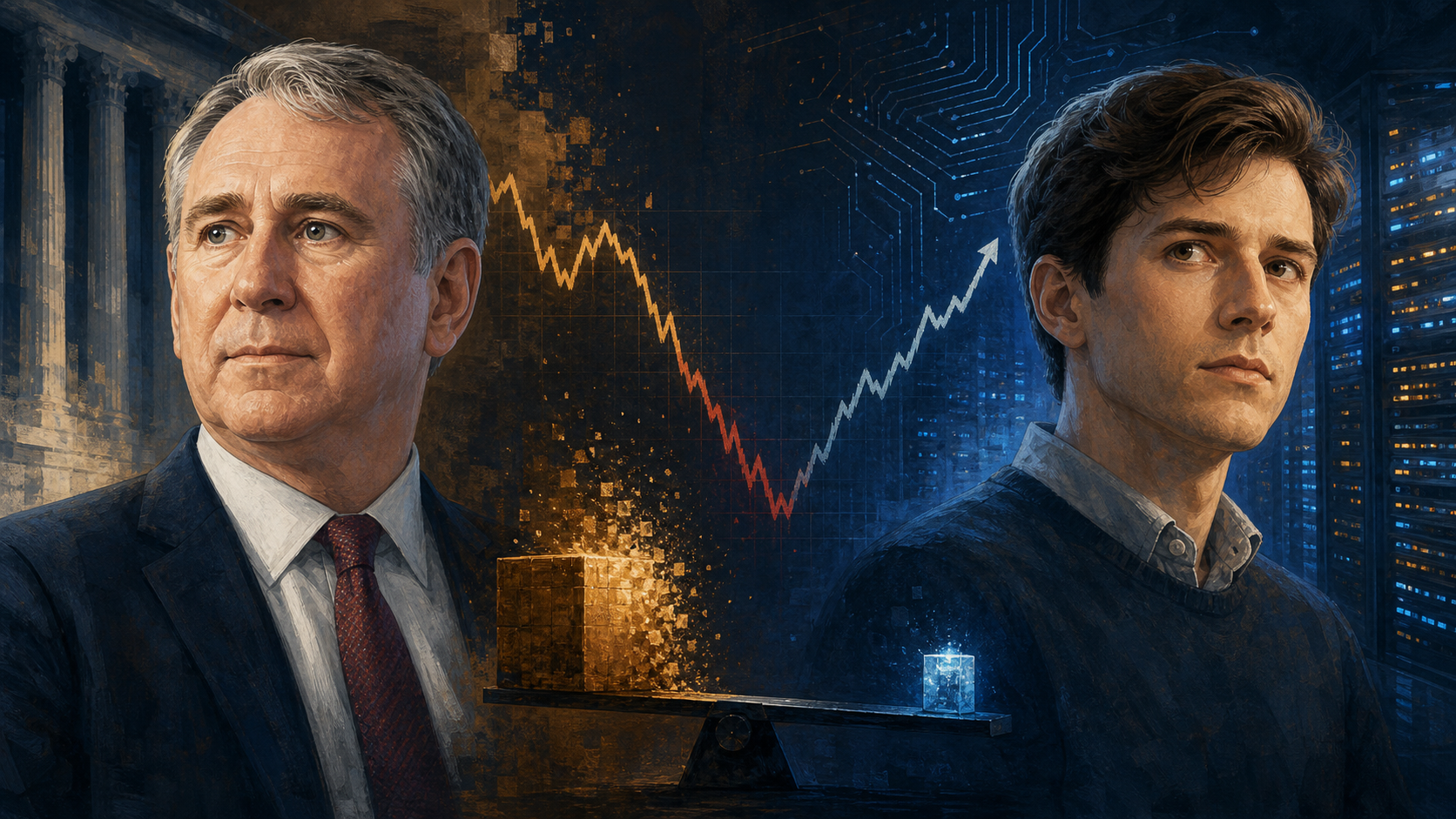
The shorthand version is that Citadel acquired Situational Awareness after a margin call. That is too simple.
Citadel did not acquire the investment firm. It acquired most, and perhaps all, of its public stock holdings, depending on the report. Situational Awareness retained private investments, including its stake in Anthropic. And although lender pressure and forced deleveraging are well documented, Reuters reported that it could not determine whether the fund had received a formal margin call before the deal.
What is clear is more important: Situational Awareness had borrowed against a volatile, concentrated portfolio. When that portfolio fell, the fund lost the ability to wait for its thesis to recover.
From AI manifesto to a $45 billion gross portfolio
Aschenbrenner was already well known in AI circles before he became a fund manager. The former OpenAI researcher published Situational Awareness: The Decade Ahead in June 2024, arguing that rapid gains in computing power and algorithmic efficiency could produce artificial general intelligence within years.
The investment version of that argument was not simply “buy AI software.” It was that the race to build more capable systems would require an enormous physical buildout: accelerators, memory, data centers, power equipment, cooling and the infrastructure needed to connect it all.
Situational Awareness was formed around that thesis. Early backers reportedly included Stripe co-founders Patrick and John Collison, Nat Friedman and Daniel Gross. By March 2026, the fund's US filing showed large positions tied to data-center power and compute, including Bloom Energy, CoreWeave, Core Scientific, IREN and Applied Digital. It also reported put positions linked to semiconductor companies and a semiconductor ETF.
The March 31 Form 13F carried a headline value of $13.68 billion. That figure was not the fund's net asset value. About $8.46 billion represented the value of shares underlying reported put options, not the market value of those options, while roughly $1.36 billion represented shares underlying calls. The disclosed common-stock positions were worth about $3.86 billion at quarter end. The filing also omitted private companies, most foreign-listed securities, borrowing, cash and short stock positions.
That distinction would matter enormously three months later.
According to The Wall Street Journal, Situational Awareness's gross portfolio reached about $45 billion at the peak. Reported assets under management had been above $20 billion, but the higher figure included the gross value of an enlarged portfolio. Those are not interchangeable measures. A fund can control $45 billion of securities without having $45 billion of investor capital if it uses borrowing and derivatives.
Leverage helped turn a strong idea into spectacular returns. It also made the fund dependent on the path the market took to reach the future Aschenbrenner expected.
Why leverage changes the deadline
Assume a fund begins with $10 billion of investor equity and borrows another $20 billion. It now controls a $30 billion gross portfolio.
If that portfolio rises 10 percent, it gains $3 billion. Before financing costs and fees, the investors' $10 billion has increased by 30 percent.
The same arithmetic works in reverse. A 10 percent decline destroys $3 billion, or 30 percent of the original equity. A 20 percent decline removes $6 billion, leaving far less collateral beneath the loan.
The lender does not need to share the manager's ten-year conviction. It cares whether the collateral covers the financing today. If asset values fall far enough, the lender can require more cash, demand that positions be reduced or change the terms on which it is willing to finance the book.
This is why “margin call” is a useful description even when the precise contractual event remains private. The economic mechanism was a collateral squeeze. Situational Awareness needed cash while the market value of the assets available to raise it was falling.
The 67% month that followed a 439% half-year
The fund reported huge gains. A client letter cited by multiple reports said it had returned 439 percent in the first half of 2026 and 1,551 percent since inception, net of fees.
Then came July. A subsequent investor letter reviewed by The Wall Street Journal said the fund lost roughly 67 percent in the month, while remaining up about 80 percent for the year.
Those figures sound contradictory, but they are mathematically consistent. A 439 percent gain turns $1 into $5.39. A 67 percent loss on $5.39 leaves about $1.78—still a gain of roughly 78 percent from the start of the year. The episode is a reminder that a large percentage loss after a large gain applies to a much larger capital base. It can destroy most of the year's accumulated dollars without making the calendar-year return negative.
The sequence also matters. On July 24, the firm told investors about its first-half performance and sought new capital. By July 30, it had transferred most of the public-equity book. The post-sale letter then disclosed the scale of July's loss. A strong year-to-date percentage did not solve the immediate financing problem.
The trade that worked became the trade that trapped the fund
A portfolio can become more fragile even as its recent track record becomes more impressive. Several vulnerabilities had accumulated at once:
- The book was concentrated around one economic system. A power company, a GPU cloud, a memory producer and a bitcoin miner can carry different ticker symbols while still depending on the same AI capital-spending cycle and the same willingness to finance it.
- The positions were volatile. Many AI infrastructure beneficiaries had risen rapidly and could fall rapidly when expectations changed.
- Borrowing shortened the holding period. A solvent unleveraged investor can choose not to sell. A leveraged fund may lose that choice.
- The most valuable private asset was less liquid. A stake in Anthropic could be worth billions while taking longer to sell than exchange-traded stocks.
- Crowding could make the exit harder. When a known portfolio begins reducing large positions, other traders can step back, hedge or demand a lower price.
The reversal arrived in June and July. AI infrastructure and semiconductor shares sold off. A separate rally in software reportedly hurt another part of Situational Awareness's book. The firm tried to raise new capital and worked with its banks to reduce exposure.
By July 30, the search for cash had become a portfolio sale.
What Citadel actually bought
The Wall Street Journal first reported that Situational Awareness sold the bulk of its stocks to Citadel. Axios reported that the entire public-equities portfolio had been sold. Reuters described the transaction as the bulk of the portfolio and said the fund had been forced to unwind most of its public equities.
The reports differ at the edge, but agree on the event: Citadel became the buyer for a very large block of public securities when Situational Awareness needed liquidity quickly.
That is not the same as Citadel endorsing every position at the previous market price. Citadel could negotiate a block discount, hedge individual exposures, distribute risk across multiple teams and hold positions with different financing from the seller.
Subsequent reporting said the discount was greater than 10 percent. That means Citadel's first layer of potential return did not require the AI stocks to recover fully. It began with the gap between the transfer price and the prevailing market value.
The buyer and seller could therefore have opposite outcomes while holding the same securities. Situational Awareness realized losses because it had to sell at the wrong time. Citadel could profit because it had liquidity at exactly that time.
The wedding-week contrast
The timing made an already dramatic financial story feel cinematic.
As the portfolio negotiations intensified, Aschenbrenner was preparing to marry Avital Balwit, chief of staff to Anthropic chief executive Dario Amodei. The Wall Street Journal reported that guests were arriving for a multiday celebration in Carmel, California, with a ceremony at a Tuscan-style villa, a forest-spa send-off and a pre-wedding colloquium.
Later public accounts describe the couple as having married that weekend. We did not find a direct public announcement from the couple; the contemporaneous Journal report documented the plans and arriving guests. The personal detail does not explain the fund's losses. It captures the compressed timeline: one of the largest AI portfolios in public markets was being dismantled as its founder entered one of the most important weekends of his life.
What remained after the sale
Situational Awareness did not disappear.
The firm retained private investments, most notably a stake in Anthropic that reports estimated at about $5 billion. But that stake was not simply untouchable. The Journal's July 31 follow-up reported that Situational Awareness had reached an agreement to sell about $3.5 billion of Anthropic shares to Sequoia Capital and Greenoaks, then withdrew from the deal the next morning.
The attempted sale changes the interpretation. Private illiquidity did not guarantee protection; it changed the process. The exchange-traded infrastructure positions could be priced and transferred as a block under immediate pressure. Monetizing Anthropic required a negotiated secondary transaction, and that transaction did not close.
The fund's future depends on facts that are still private: remaining investor capital, liabilities to financing banks, redemption requests, the exact terms of the Citadel transaction and the value ultimately realized from its private holdings.
The lesson is not “AI was wrong”
Nothing in the sale proves that AI investment will slow, that Anthropic is overvalued or that data-center demand will collapse.
It proves that a correct long-term thesis can still produce a disastrous portfolio outcome when concentration and leverage remove control over the exit date.
There are three separate questions:
- Is the AI infrastructure thesis directionally right?
- Were the securities purchased at prices that offered an adequate return?
- Could the portfolio survive the volatility required to reach that return?
Situational Awareness may yet be right on the first question. The forced transfer of its public book shows that the third question can overrule the other two.
That is the whole transaction in one sentence: Citadel did not buy the future from a failed AI prophet; it bought time from a seller who had run out of it.
The paid issue examines the less obvious market signal: why the reported 13F never showed the fund's true risk, how Citadel earned a return at the moment of purchase, and what investors should measure before copying a high-conviction portfolio.
Sources and reporting notes
- Wall Street Journal: Citadel buys Situational Awareness's stock portfolio
- Reuters: Citadel buys most of Situational's stock holdings
- Axios: AI-focused hedge fund sells its public equities
- Wall Street Journal: the fund's collapse during Aschenbrenner's wedding week
- Wall Street Journal: Situational Awareness lost about 67% in July
- Wall Street Journal: Citadel's discounted purchase is already paying off
- Financial Times: Citadel bought a large portion of the $16 billion public portfolio
- SEC: Situational Awareness LP Form 13F for March 31, 2026
Research cutoff: August 7, 2026. The transaction terms, financing agreements and current private-asset values are not public. Figures attributed to unnamed sources are identified as reported rather than independently verified.
Members-only research
Members are reading this
Aug 7, 2026
Issue 04: Citadel Bought Time at a 10% DiscountThe buyer did not need a better AI forecast. Citadel was paid to provide liquidity when Situational Awareness could no longer finance the path to its own long-term thesis.
Feb 23, 2026
Newmont and the gap between a gold rally and shareholder cashA February 23, 2026 historical cutoff tests whether portfolio simplification and cost control could turn stronger gold economics into cash.
The thesis, the numbers behind it, and what would break it. Full access is $15 a month.
Read the full research